
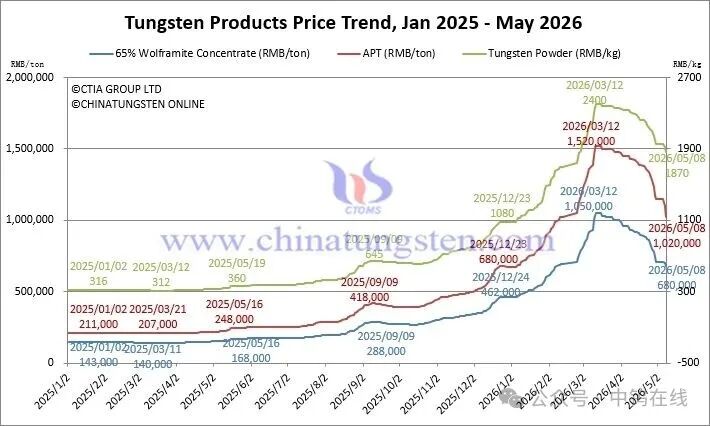
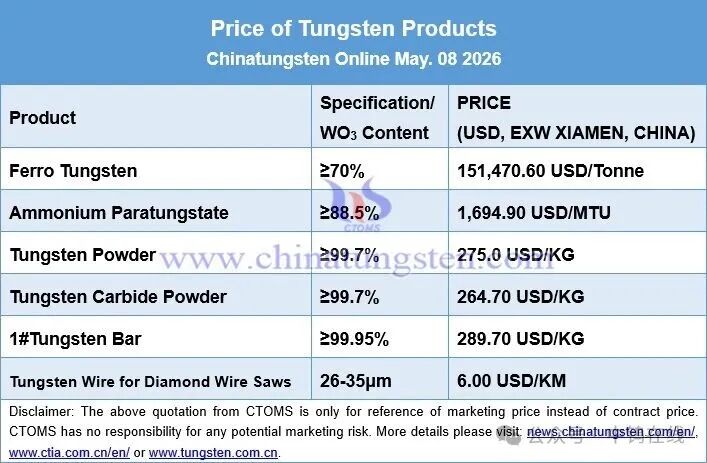
Tungsten prices are in a short-term correction, mid-to-long-term bullish trend, with limited downside and solid upside potential.
• Short term (1–2 months): After hitting historic highs in March 2026, tungsten prices (e.g., 65% wolframite concentrate) have corrected by over 33% by early May, entering a shock-absorbing and bottoming phase. Prices are nearing mine production costs (~RMB 500,000–600,000/ton for concentrate), leaving little room for further sharp declines.
• Medium term (3–6 months): Supported by tight supply (China’s mining quotas remain strictly controlled; overseas new supply is limited to ~10,000 tons in 2026) and recovering demand (peak seasons for cemented carbide and PV tungsten wire), prices are expected to stabilize and rebound from mid-May. Key events like the China Tungsten Industry Conference (May 7–9) will likely set a positive tone for the market.
• Long term (1+ years): The core logic of supply rigidity + demand expansion remains unchanged. Emerging demand from PV tungsten wire, semiconductors, and defense will keep the market tight, driving prices to surpass previous highs.
How Do Tungsten Price Hikes Affect Drill Bit Quality?
Rising tungsten prices do not reduce drill bit quality—instead, they accelerate product upgrades and stabilize quality at the high end, while squeezing low-end, low-quality capacity.
• Quality remains stable for premium brands: Tungsten (as tungsten carbide, WC) accounts for 75%–92%of drill bit material composition and 40%–60% of production costs. Leading manufacturers (e.g., our company) use long-term supply contracts to lock in 70%+ of raw material needs, avoiding cost-driven material downgrades. Strict quality control and advanced sintering/coating processes ensure consistent hardness, wear resistance, and impact toughness.
• Industry shifts toward innovation, not cost-cutting: To mitigate cost pressures, manufacturers are optimizing designs (e.g., exchangeable-head systems to reduce WC usage by 30%+ without sacrificing performance) and adopting high-performance coatings (e.g., TiN, DLC) to extend tool life by 2–5 times. These improvements offset cost increases and enhance overall value.
• Low-end market faces quality elimination: Smaller manufacturers without raw material security may resort to lower-grade WC, reduced WC content, or thinner coatings to cut costs, leading to higher risks of chipping, premature wear, and shorter service life. This accelerates industry consolidation, with quality leaders gaining market share.
Post time: May-08-2026