
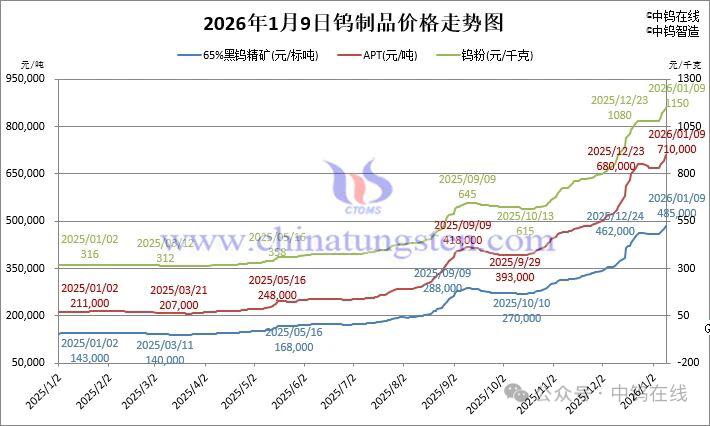
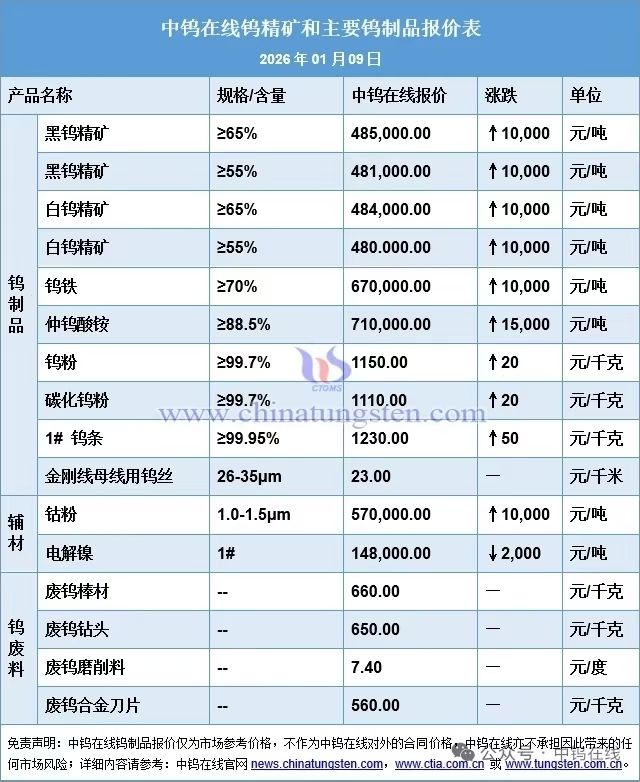
Domestic tungsten powder: ¥1,130,000–1,150,000 per ton, up ¥20,000 per ton
Domestic primary tungsten carbide: ¥1,100,000–1,120,000 per ton, up ¥20,000 per ton
A Word on Tungsten Price Hikes
When military demand outstrips supply, civilian sectors are left scrambling for limited stocks. May world peace prevail ☀️☀️☀️
Applications of Tungsten
1. Armor-Piercing Projectile Cores
Tungsten alloys (tungsten-nickel-iron/copper alloys) are the preferred core material for modern armor-piercing fin-stabilized discarding sabot (APFSDS) projectiles. With high density (approx. 18g/cm³, 2.3 times that of steel) and exceptional hardness, they maintain kinetic energy during high-speed flight to penetrate composite armor of enemy tanks and armored vehicles.
Typical Applications: The U.S. military’s M829 series and China’s 125mm tank gun APFSDS both adopt tungsten alloy cores. 2. Fragmentation Warheads
Tungsten alloy fragments feature high density and stable flight performance. In missile and artillery warheads, they form high-speed lethal fragments, boosting damage efficiency against personnel and equipment.
3. Submunition Warheads
Used for anti-armor and anti-cluster target operations, they deliver precision strikes by leveraging the high kinetic energy of tungsten alloys.
4. Core Components of Weaponry and Equipment
• Artillery Barrel Liners/Muzzle Brakes: Tungsten boasts excellent high-temperature wear resistance, making it ideal for wear-resistant liners to extend artillery barrel service life. Key components of muzzle brakes also use tungsten alloys to withstand the impact of high-temperature, high-pressure propellant gases.
• Missile Engine Components: Tungsten matrix composites are applied in nozzle throats and heat shields of solid rocket motors, withstanding gas scouring at temperatures above 3,000℃ to ensure stable engine operation.
• Aeroengine Critical Parts: As an alloying element in nickel-based superalloys, tungsten enhances high-temperature strength and creep resistance for turbine blades and discs in military aircraft engines.
5. Protective Equipment and Special Devices
• Armor Protection: Tungsten alloy armor plates offer high density and superior protective performance in a much smaller volume compared to steel armor of equivalent protection. They are used for critical protection of tanks, armored vehicles, as well as helicopter and military aircraft cockpits.
• Gyroscope Rotors: The high density and rigidity of tungsten alloys make them the core rotor material for military gyroscopes and inertial navigation systems, ensuring navigation accuracy and stability.
• NBC Protection Devices: Tungsten’s excellent radiation shielding properties make it suitable for shielding components in military nuclear radiation detectors and nuclear protection equipment.
6. Other Special Military Applications
• Military Knives/Drilling Tools: Tungsten steel (cemented carbide) tools feature high hardness and wear resistance, suitable for military daggers and special operations drilling tools to meet cutting and drilling needs in complex battlefield environments.
• Electromagnetic Railgun Track Materials: Tungsten matrix composites are under research for electromagnetic railgun tracks, withstanding the dual effects of strong electric currents and high temperatures to extend track service life.
Core Strategic Significance
Tungsten’s military applications are irreplaceable, and its supply security is directly tied to weaponry performance and national defense safety. China is the world’s largest tungsten resource holder (accounting for approximately 60% of global reserves) and a leading tungsten processing power, providing critical support for the independent development of the country’s military equipment.
Post time: Jan-09-2026